
Fanmania
During the nineteenth century, handheld fans achieved unprecedented popularity throughout European society. A newfound artistic appreciation for these objects also emerged, fueled by cultural crazes for all things Japanese and Spanish as well as by exhibitions and publications devoted to fan making and its history. “Almost all the great artists of the century have contributed . . . to the decoration of the best fans,” wrote the author Octave Uzanne in 1882.
For the fourth Impressionist exhibition of 1879, Edgar Degas envisioned an entire gallery devoted to fans. Though the fan-shaped paintings his colleagues submitted were ultimately dispersed throughout the show, they nevertheless elicited strong responses from the public, including bewilderment, as illustrated below. Today, these works continue to raise questions—mainly, why did ambitious European artists adopt this accessory as a format for their work?
Bringing together artworks from across The Met, Fanmania explores the reasons artists were drawn to this semicircular form, including its commercial potential, its fashionability, and the opportunities it offered for formal and technical innovation. Although avant-garde fans were primarily designed for display rather than use, they retain many of the associations of functional fans. Themes of gender, courtship, appropriation, and experimentation unfold in this examination of fans as objects of adornment, decoration, and communication in the nineteenth century.
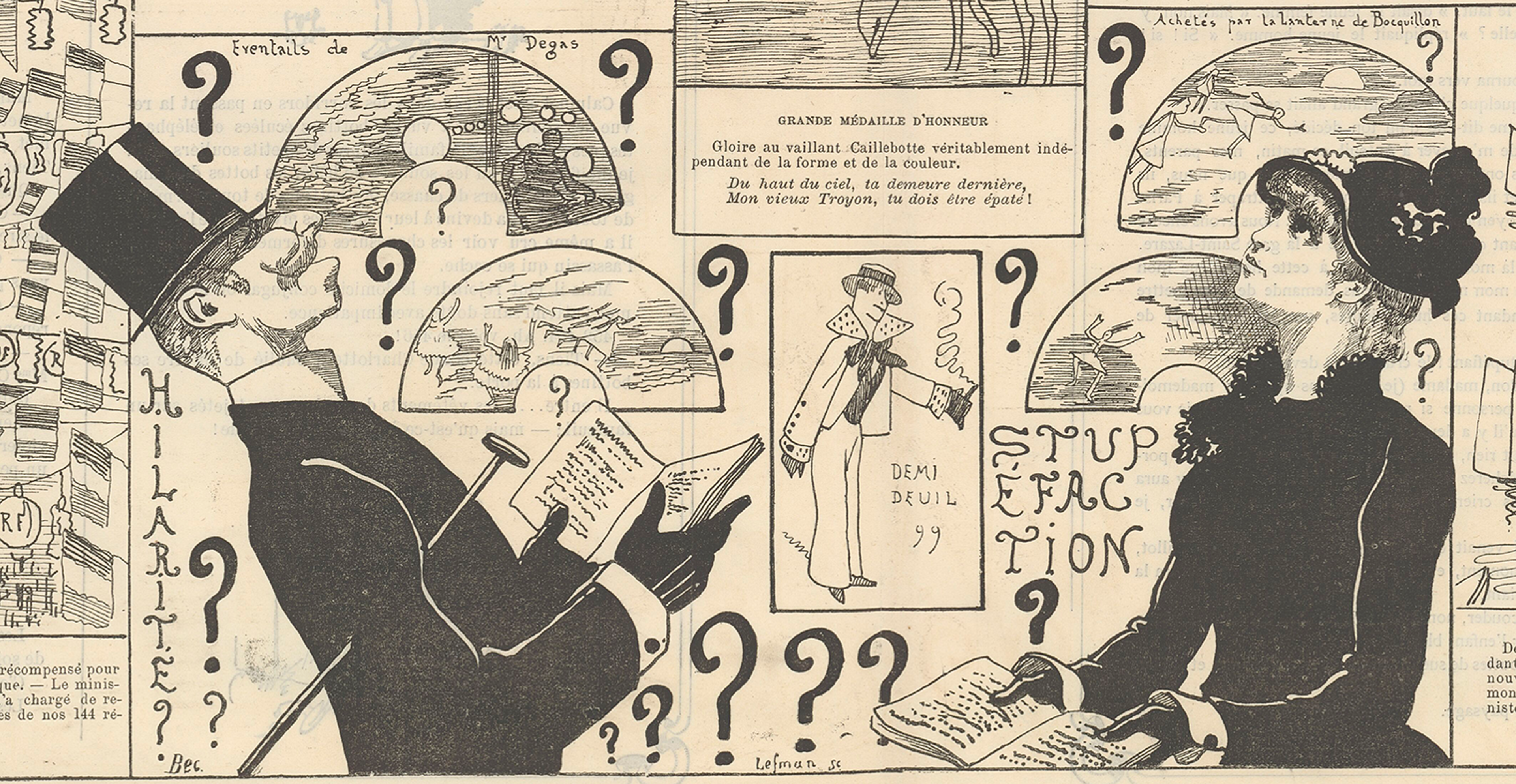
[Image caption:] Ferdinand Lefman (French, 1827–1890) after Georges Tiret-Bognet (“Bec”) (French, 1855–1935). “A Glance at the Independents [the Impressionist Exhibition]” (detail), Le Monde Parisien, May 17, 1879
Selected Artworks
Press the down key to skip to the last item.
The Art of the Fan before 1800
Handheld folding fans are multimedia objects that involve many types of artistry and artisanal skill. This show focuses primarily on the role of painters and printmakers in the production of the fan’s semicircular leaf. In Europe, prior to 1700, most of these designs were unsigned. In the nineteenth century, major artists grew increasingly interested in making fans and began signing their work, as did preeminent fan-making houses, which evolved out of earlier guilds. Some of the precedents for these practices are on display here.
Historically, European fans have been most closely associated with the eighteenth century, when their use became widespread. The examples here show the various roles fans played, including as tools for flirtation, amusement, education, propaganda, observation, and masquerade. Fan leaves communicated through their subjects and style, while users brought them to life through their gestures. Women were not only the consumers of fans but also among their producers, as fan making was considered an art form appropriate for female practitioners, whether amateur or professional.
Selected Artworks
Press the down key to skip to the last item.
Fans of the Opera
Handheld fans found perhaps their most prominent public display in the opera house. The atmosphere of spectatorship and performance—present both onstage and among the audience—heightened attention to fans in the hands of female theatergoers. The emphasis on seeing and being seen even gave rise to fan designs that incorporated opera glasses, or lorgnettes (from the French lorgner, “to ogle”), and small mirrors. A lorgnette fan is on view in the case nearby. Fan makers also developed a genre of fans devoted to the opera. These fans incorporated scores, lyrics, and homages to celebrated composers.
As theatergoing grew more popular later in the century, Impressionist artists seized on the novel subject of spectators in the theater loge. The fashionability and ubiquity of fans at the opera had become fully apparent by the early 1880s, as evidenced by the cartoon below.
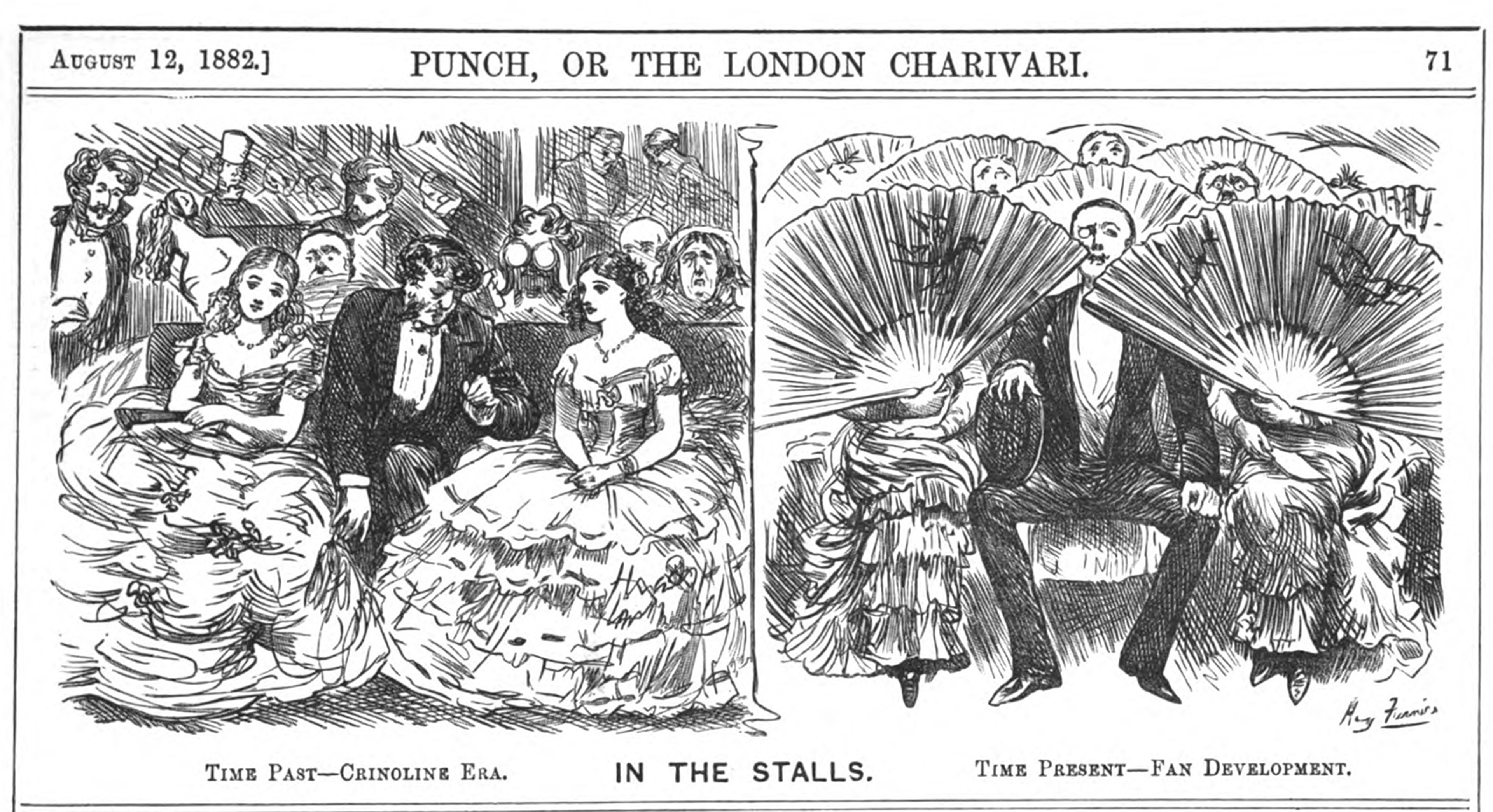
[Image caption:] Harry Furniss (British, 1854–1925). “In the Stalls,” Punch, August 12, 1882
Selected Artworks
Press the down key to skip to the last item.
Fans in Motion
Movement is an essential aspect of the handheld fan. The nineteenth-century critic Charles Blanc wrote that the fan is “above all things . . . a means or motive of gracious movements, under pretext of agitating the air for the sake of coolness.” The expressive qualities of a fan’s motions are among the ways it can convey meaning and reveal the user’s personality, mood, or intentions. Fans can flutter, vibrate, waft, snap, open, shut, rise, and even fall (or be deliberately dropped) at a particularly opportune moment before a potential suitor.
Artists in the late nineteenth century understood the fan as a moving object and attempted to capture its dynamism in myriad ways. The fleeting and ephemeral nature of its movement surely made it an appealing subject for the Impressionists. Fan designs frequently incorporate metallic paints, gold leaf, feathers, spangles, and sequins, the visual impacts of which are heightened when in motion.
Selected Artworks
Press the down key to skip to the last item.
Japonisme
The term “Japonisme” was first used by French critics in the early 1870s to describe the passion for Japanese art and culture they observed among their contemporaries. Japanese goods became increasingly available in Europe after the United States forced Japan to open its ports to international trade in 1853–54. The 1867 and 1878 Universal Exhibitions in Paris were pivotal events in Europeans’ exposure to the arts of Japan. Many Impressionist artists and their friends collected such works, including fans, acquiring them from newly established specialist dealers and shops. By the late 1880s, Japanese fans were imported in the millions to France, where they were used as women’s accessories and decoration.
European artists focused on the aesthetic value of these objects and borrowed from them liberally, often with little understanding of their original contexts. Today, some would call this cultural appropriation, though subtleties of interpretation varied. Certainly, the history of Japonisme is fraught, but the admiration for Japanese fans freed European artists to imagine new techniques and strategies for their art.
Selected Artworks
Press the down key to skip to the last item.
Fans of Spain
In the nineteenth century, Spain became a center of fan production at the same time that the country’s tourism industry emerged and its culture was increasingly exported throughout Europe. Reporting from his travels to the Iberian Peninsula in the early 1840s, the French writer Théophile Gautier claimed, “A woman without a fan is something I have not yet seen in this happy country.” The fan’s prominent role in Spanish flamenco dance is likely another reason it became inextricably linked with Spain in the nineteenth-century imagination, and remains so today.
In Paris at mid-century, Spanish culture was in vogue, a phenomenon known as Hispagnolisme. Spanish-born empress Eugénie de Montijo, who married Napoleon III in 1853, exerted considerable influence on fashion and taste. Spanish dance troupes and musicians performed often in the capital, and avant-garde artists, such as Edouard Manet, took them up as subjects. For some artists who made fans in this period, it was Spain that they had foremost in mind. Manet and Degas both chose Spanish themes for their earliest fan designs.
Selected Artworks
Press the down key to skip to the last item.
Fans and the Feminine Subject
The theme of the bourgeois woman with her fan in a domestic setting proliferated in art of the last quarter of the nineteenth century. In his 1882 book The Fan, the French writer Octave Uzanne described the role of fans to his female readers: “In all solitude, in every despair, it will remain your confidante.” Whether at home or on ventures out, the handheld fan served as a companion, trusted protector, and elegant accoutrement.
As fashion accessories, fans signaled facets of their user’s identity through their materials and stylistic form as well as in the way they were handled. “One wave of the Fan is sufficient by itself to distinguish between a princess and a countess, a marchioness and a plebeian,” remarked one female observer cited by Uzanne. A Japanese uchiwa fan in the hands of the Impressionist Berthe Morisot or a plumed fan held by one of Mary Cassatt’s sitters displayed their alignment with current taste and confirmed their social status.
Selected Artworks
Press the down key to skip to the last item.
Souvenir and Advertising Fans
Fans were among the first souvenirs, used since the seventeenth century to commemorate events and to remember visits to important sites. As travel increased in the eighteenth and nineteenth centuries, fans became popular as small, practical, and artistic objects that could serve as mementos. The Universal Exhibitions of the second half of the nineteenth century played a crucial role in promoting the French fan industry and exposing the European public to fans from other cultures. Souvenir fans were produced for each of these events, providing visitors with information and maps while also recording the remarkable buildings erected specifically for these occasions.
Industrial advances in color lithography and a growing population of middle-class consumers gave rise to advertising fans in the late nineteenth century. Fans promoting rail travel and holiday destinations, for example, were given away to potential customers. By the first decades of the twentieth century, fans publicized department stores, perfume, champagne, alcohol, hotels, and restaurants.
Selected Artworks
Press the down key to skip to the last item.